
Erie County Prison Booking Releases
Erie County booking releases are processed through Erie County Prison in Erie, Pennsylvania. The facility records every arrest made in the county, creating a booking record that captures charges, bail amounts, court dates, and personal details for each person taken into custody. An online inmate locator supports searches by last name, first name, first initial, or offender ID. Records are maintained under Pennsylvania's Right-to-Know Law and are available through the county corrections department.
Erie County Prison Facility Details
Erie County Prison is located at 1618 Ash Street in Erie, Pennsylvania 16503-2168. The facility phone is 814-451-7500, and the email address for corrections inquiries is correctionsinfo@eriecountypa.gov. The facility has a rated capacity of approximately 1,200 and maintains an average daily population of around 980.
The mission of Erie County Prison is to protect society while maintaining a safe environment for both staff and inmates. The prison accepts inmates from the U.S. Marshal's Service and the Erie Police Department in addition to arrests made by Erie County law enforcement agencies. This broad intake responsibility reflects Erie County's position as a regional hub in northwestern Pennsylvania, bordering both Ohio and New York State along the southern shore of Lake Erie.
Inmates at the facility are housed in pods. Each pod consists of a large common area with cells arranged on two levels. All inmate movement occurs under staff supervision. Inmates who qualify for trustee status take on work assignments including cooking, laundry, and commissary management. This structure provides meaningful daily activity and operational support for the facility.
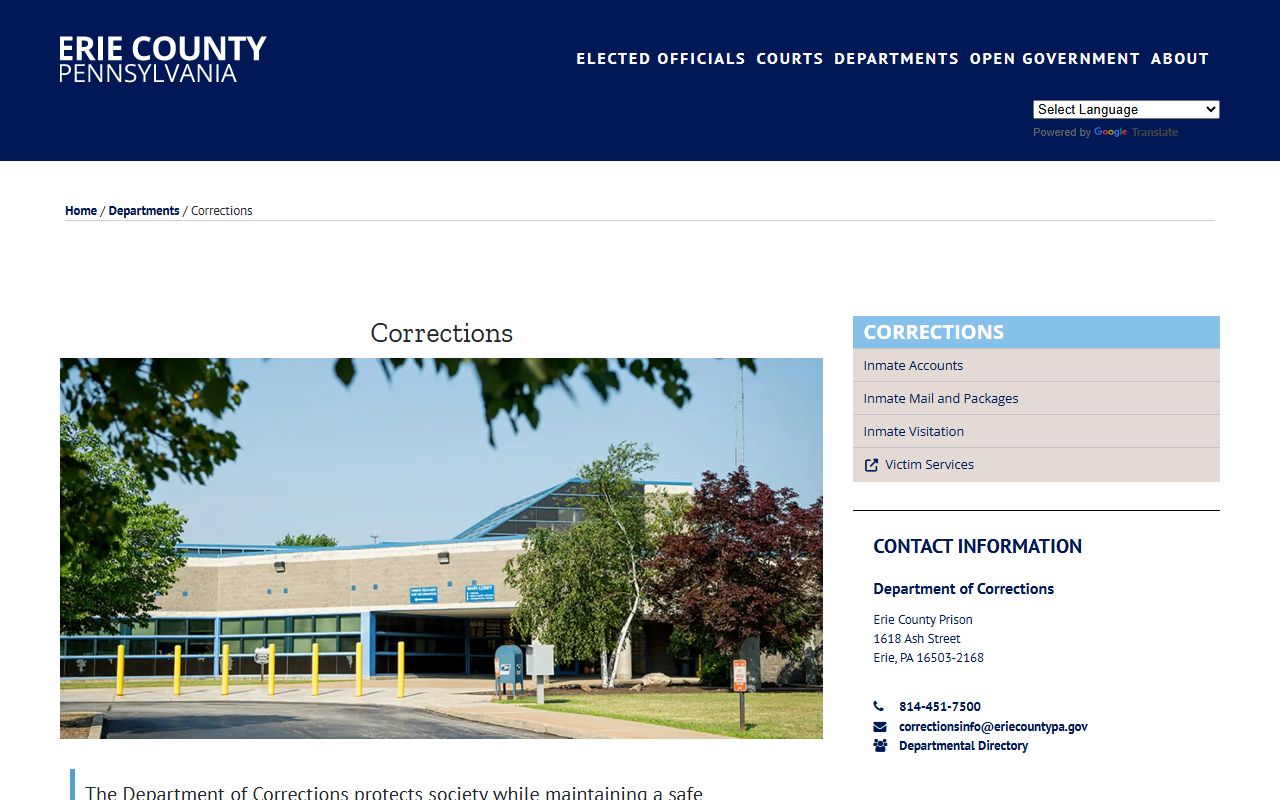
The Erie County corrections department page at eriecountypa.gov provides access to the inmate locator, visitation rules, mail and phone information, and other resources for families of incarcerated individuals.
Intake Process at Erie County Prison
Every person brought to Erie County Prison goes through a structured intake process. On arrival, staff conduct a complete property inventory of all items the individual had at the time of arrest. A medical screening follows to identify any immediate health needs and document existing conditions. The booking process creates the formal record, assigning a unique booking number and taking the individual's photograph. Housing assignment is determined through classification based on charge severity, criminal history, and available space.
New detainees who are not able to post bail within 24 hours must appear before a judge. That first appearance can take place in person or by phone. The preliminary arraignment sets the initial bail amount. Individuals who meet bail conditions are released; those who do not are housed at the facility and assigned to a pod until their case resolves.
Registered offenders in Erie County are also searchable through the online locator. Visitation times and rules are posted on the corrections department website. Detailed information on sending money, mail, and medications to an incarcerated individual, as well as phone usage policies, is also available there.
Note: If you are unsure whether someone is currently held at Erie County Prison or at a state facility, check both the county locator and the Pennsylvania DOC inmate search tool, since the two systems are separate.
What Erie County Booking Records Document
Each booking record at Erie County Prison captures the individual's full legal name and known aliases, physical description, and a booking photograph. The record assigns a unique booking number and documents the date and time of booking. Every charge filed against the individual is listed, along with the applicable statute and the bail or bond amount set at arraignment.
Court dates are noted as they are scheduled. Prior bookings at the same facility may also appear in the record. Charge descriptions are included for each count, covering the full range of offenses handled by Erie County law enforcement, from drug possession and assault to theft, burglary, and more serious felony charges.
These records are formal government documents that reflect the exercise of law enforcement authority. They are presumed public under Pennsylvania's Right-to-Know Law. Under 61 Pa.C.S. § 4103, county correctional facilities follow state rules on record access and retention, ensuring that records remain available to the public for a defined period.
Right-to-Know Requests and Erie County Jail Records
Pennsylvania's 65 P.S. § 67.101 et seq. covers all records held by Erie County government agencies, including the corrections department. Written requests for booking records that are not available through the online locator go to the county's Right-to-Know officer. The agency must respond within five business days. Standard copy fees are $0.25 per page.
Denied requests may be appealed to the Pennsylvania Office of Open Records within 15 business days of the denial letter. The Office of Open Records reviews the denial and issues a binding decision at no cost to the requester. Appeals must be filed in writing and should reference the original request and the agency's denial.
The Erie County corrections department website provides information on how to contact the department by phone and email. For questions that fall outside the formal RTKL process, the department's public contact information at correctionsinfo@eriecountypa.gov is a useful starting point.
Court Records via UJS Portal
Booking records capture the state of a case at the time of arrest. Everything that happens after that, including arraignments, preliminary hearings, trial, and sentencing, is tracked through the Pennsylvania Unified Judicial System. The UJS portal allows public searches by name or docket number for all Erie County court cases.
Erie County operates a Court of Common Pleas and multiple Magisterial District Courts. The preliminary arraignment, which sets bail, is typically handled at the Magisterial District Court level within hours of booking. As a case moves toward trial, the docket in the Court of Common Pleas grows to include all subsequent filings, hearings, and orders. Court dates listed in a booking record are subject to change; always check the UJS portal for current scheduling.
VINE Victim Notification and State Resources
Victims of crimes in Erie County can register for free automated custody notifications through the VINE system. Registration is available online or by phone. Users receive alerts when a monitored person's custody status changes at any participating Pennsylvania facility. The service covers Erie County Prison, neighboring county jails, and state correctional institutions.
For individuals sentenced to state prison, the Pennsylvania DOC inmate and parolee locator covers those cases. The state locator and the county system are separate tools; checking both ensures you have the most complete picture of an individual's custody status. The Pennsylvania Department of Corrections website also provides information on state supervision, parole, and reentry services for individuals nearing the end of a state sentence.
Record Correction and Expungement in Erie County
Errors in an Erie County booking record can be addressed by contacting the corrections department in writing. Clerical mistakes such as spelling errors or incorrect dates are typically corrected with supporting documentation. Disputes about the accuracy of underlying charges require documentation from the Erie County Court of Common Pleas.
Expungement is a court-based process in Pennsylvania. An attorney must file a petition with the Court of Common Pleas. The process takes one to two years from start to completion. Not all charges are eligible. Until an expungement order is entered and processed, the booking record remains accessible in public databases. The UJS portal confirms whether an expungement order has been entered on a specific docket. Third-party websites that archive older records must be contacted separately for removal after a court order is in place.
Nearby Pennsylvania Counties
These neighboring counties maintain their own booking release records under Pennsylvania's Right-to-Know Law.